

Batman Arkham Knight Batman Kills Joker
 |
|
In most continuities, Batman retains a set of rules and codes around how far he should become. These often are done to either go along inside the lines of the constabulary, retain his own empathy or end him from going beyond redemption. Over the years, they have by and large become simplified to either No Killing or No Guns rules, though the contents of these have also ensured he doesn't inflict brutal violence upon others. Nonetheless, some incarnations, including the mainline Batmen, have either broken or not retained these.
History
Golden Age
When start introduced, Batman did not accept any concern most the lives of his enemies. His first confirmed kill was in Detective Comics #27, where he knocked Alfred Stryker into a vat of acid. Batman continued to murder criminals, crusade their deaths or leave them in lethal situations. In some stories, he also wielded a pistol. Both Pecker Finger and Bob Kane mentioned this was due to the influence of pulp activity heroes in comics, such every bit The Shadow and Green Hornet. Both were well known for wielding firearms and frequently used lethal methods to dispatch enemies.
This continued until Batman #one, where he gunned down Hugo Strange'south henchmen and hung one of the Monster Men with a noose from the Batgyro. Withal, the story featured Batman's get-go indication that he disliked taking lives and was only using lethal strength because he saw it necessary on this occasion. According to Bob Kane, this incident evoked complaints from parents, due to children condign interested post-obit the introduction of Robin. This led editor Whitney Ellsworth to tell Finger to never have him use guns over again. The editor later created a policy for all published characters from killing, which stated "Heroes should never kill a villain, no matter the depths of his villainy."
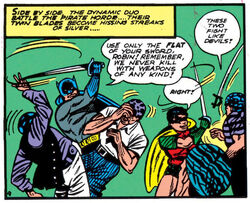
The debut of Batman's "rules"
Officially, Batman's "no killing" rule came into affect in Batman #4. During a swordfight with pirates, Batman tells Robin "Use but the apartment of your sword, Robin! Remember, we never kill with weapons of any kind!"[ane] Furthermore, the character began working alongside the Gotham Urban center Police Section and was deputized equally an amanuensis of the law. These now meant Batman was no longer considered a vigilante and would have to work within the guidelines of the police.
Despite these changes, Batman all the same continued to kill criminals in his stories, though most were indirectly caused past either knocking them into hazards or throwing them off buildings. However, direct kills were gradually phased out, though they still continued to occur albeit rarely.
Batman'southward utilize of lethal tactics finally stopped later a trip to the frontlines of World State of war II during Batman #15. This upshot was notably i of the largest sprees in his history, causing a vehicle crash and subsequently destroyed an unabridged warship full of soldiers. The issues also depicted Batman using a machine gun on the cover of the issue.
After this incident and with the new policies in identify, Batman would not impale his enemies and even try to forestall their deaths. He also stopped using weapons that could be used to crusade deadly harm, such equally guns and swords. Some stories would justify this as him allowing the courts to serve justice, with the character now being on the side of the police force and the law.
Silvery Age
Due to Fredric Wertham'southward Seduction of the Innocent targeting comics for trigger-happy acts and blaming them for juevinial delinqency, the Comics Magazine Association of America created the Comics Code Authority's guidelines to prevent authorities intervention. Comic books, including issues of Batman and Detective Comics, would need to abide past these if they wished to be published, significant Batman and other characters had to abide to stricter rules.
Some of these guidelines included:
- Scenes of excessive violence shall be prohibited. Scenes of cruel torture, excessive and unnecessary knife and gunplay, physical desperation, the gory and gruesome law-breaking shall be eliminated.
- Inclusion of stories dealing with evil shall exist used or shall exist published only where the intent is to illustrate a moral upshot and in no case shall evil be presented alluringly, nor so equally to hurt the sensibilities of the reader.
These meant that Batman could no longer be portrayed as a vigilante operating on the edge or use excessive violence, though these rules had been in identify since 1940. This also meant that Batman and Robin could not become into fights nor use direct violence on their enemies. The codes also meant that criminals could non be portrayed sympathetically and stories could not sow distrust in potency. As such, the Dynamic Duo were to solely focus on criminals and not investigate issues like police abuse. Ironically, it also meant that Batman'due south supervillains could also not be shown committing violent crimes, including acts of murder or gang wars. These codes would remain in place until they were updated in the early-1970s. The new portrayal of Batman and his enemies would heavily influence the 1960s Batman series and how Batman was presented.
The only notable fourth dimension Batman killed during the Silver Historic period was in 1968'southward The Dauntless and the Bold #84. In a World War II story, an surreptitious Bruce Wayne used explosives to destroy a aeroplane shooting at him and the Like shooting fish in a barrel Company. Later, the group planted charges on a span to destroy it and an entire battalion of soldiers, with Bruce being the one to detonate them. However, given the time-frame in question, it could exist argued that it was earlier Batman adhered to the not-lethal codes or took on Robin as his sidekick. The story also came at a time when Julius Schwartz was trying to reinstate the darker Batman seen in the later 1930s and early-1940s.
Statuary Age
 | This section is a stub. You can assist the Batman wiki by expanding information technology. |
With the Comic Codes existence restrained in the early-1970s, Batman began to accept a somewhat looser approach to non-lethal crime-fighting. Many of these came at the hands of incidents that the villains fell into, though most were indirectly caused by Batman. These usually ranged from moves pulled in self-defense to indirectly causing incidents. Despite this, he nevertheless would not employ guns. However, swords and bows began to reenter his arsenal, primarily due to encounters with the newly-met Ra'southward al Ghul and his League of Assassins.
The first of Batman's murders during this time was in Batman #221, where the Dark Knight tossed Otto Kramm into a pit with a killer lamb the scientist created. In narration, it is mentioned that the ii killed each other off-panel and Batman regarded information technology as "a fitting end" for the villain.
Night Historic period
 | This section is a stub. Y'all tin can help the Batman wiki by expanding it. |
Following the company-broad reset of the Crisis on Infinite Earths, Batman is established as fugitive death from the start; Batman: Year Ane sees him even subject himself to a beating to stop a random criminal falling off a burn escape during an early patrol. Some other early on case sees Batman employ a flamethrower in the Bat-boat, but this is explicitly used only to finish a gunkhole that is still close to the coast so that the criminals using it tin can swim to shore, and Batman is stated to have phased out such extreme weapons.
Ane storyline saw the Dark Knight abandon the killer the KGBeast in a locked room in the sewers after an intense battle, with the implication being that he would leave the KGBeast to slowly die, but later appearances by the KGBeast reveal that Batman sent police force to find him in one case the killer was sufficiently weakened to exist arrested.
When Jean-Paul Valley took over the drape of Batman, the moment that drove Bruce Wayne to take back the mantle himself was when Valley's deportment led to the deaths of serial killer Abattoir and his hostage, Graham Etchison, Wayne and his allies all agreeing that Batman cannot kill. Wayne has also refused to permit his allies to acquit guns (with the exception of Alfred, justified given Alfred's greater age and how he doesn't accompany them on patrol).
21st Century
| | This department is a stub. You can help the Batman wiki by expanding it. |
Modern Age
| | This department is a stub. You tin assistance the Batman wiki by expanding it. |
Other Versions
Aside from the "Earth Ane/New World/Prime-Earth" Batman, many different versions take been established to possess like rules and codes of conduct.
- Earth-1: In the Batman: Earth One graphic novel series, Batman is depicted as adopting a no-killing rule afterwards rumors circulate that he'd murdered the mayor. These also include avoiding leaving criminals in potentially deadly situations. Nonetheless, Batman is too shown paying the True cat for information, despite her beingness a wanted criminal. He also gives Killer Croc a place to hibernate from the regime despite him beingness wanted for theft and assault, thereby harboring a fugitive.
- Globe-two: Later on the establishment of the DC Multiverse, the Golden Age Batman stories and activities were retconned to accept been undertaken by the Earth-2 Batman. These included the initial encounters, including deaths of criminals at his easily. These also included adoption of the codes later on allowing Robin to join his war on law-breaking.
- Globe-31: In The Dark Knight Returns, Batman is depicted as more brutal and trigger-happy compared to other counterparts. These range from using torture to gain data and using guns when necessary. During a confrontation with the mutants, Batman is forced to shoot a member to save a hostage's life. The story remains ambiguous whether they were killed, though charges made against Batman by Ellen Yindel imply that they survived. Batman also considers gunning downwardly the Mutant Leader from inside the Riot Tank Batmobile, though decides confronting it. He also breaks the Joker's neck during their final battle, though information technology remains ambiguous whether Batman killed him or whether the Joker finished himself off to frame him. In the sequel Batman: The Night Knight Strikes Again, Batman is shown as having abandoned these codes, using vehicles and weapons to impale opponents. He also has modified the Batsuit's cape to slice through enemies. Batman also allows the expiry of multiple characters, including Lex Luthor and the new Joker.
-
- In the prequel All Star Batman and Robin the Boy Wonder, Batman is shown equally a vehement sociopath who'south more than willing to kill enemies or leave them in almost-certainly lethal situations to die. He also abducts a traumatized Dick Grayson and forces him to join his war on crime, even verbally, psychologically and physically abusing him. Batman's actions in the comic have been widely criticized, with many regarding his depiction as incredibly unlikeable and unsympathetic.
- Earth-43: In the Batman: Red Rain trilogy, Batman is turned into a vampire in order to defeat Dracula. Initially afterwards the transformation, Batman sustained himself using a claret substitute devised by Tanya, a rogue vampire who had as well opposed Dracula. While he did kill at this point, all his victims were other vampires, Batman justifying this action as the vampires weren't even alive (although another vampire countered that this was a weak justification because that Batman was a vampire himself). Somewhen, events led to Batman succumbing to his new thirst for blood and driving him to kill his human being villains, although he was able to restrict himself to only those criminals who were themselves killers, and the series ends with him walking into the sunlight to destroy himself so that he cannot endanger his metropolis farther after his enemies have all been destroyed.
In Other Media
Telly
60'due south Batman
In the 1960s Batman series, Batman does not either use weapons or kill whatever of his enemies. This was primarily due to influence from the Silver Age depictions of his grapheme. The show presents these every bit him giving them the risk to reform and do proficient for society. Batman likewise attempts to relieve criminals from situations that were potentially lethal. Despite this, he is also depicted equally open up-minded enough to consider other causes or even challenge dominance, primarily suborn attitudes from Commissioner Gordon and Master O'Hara.
The same codes also carry over to Batman: The Picture. Though some bespeak to the apparent deaths of the Five Republic of guinea Pigs, their fates arguable residual in the easily of their boss, Penguin, past restoring them with heavy water used for the Batcave's atomic pile. Though Batman and Robin both set on and cause the transformation of two of the Republic of guinea Pigs, they were unaware of their nature and Batman indicates they may have survived, though merely as Anti-Matter. Whilst chasing the villains, Batman allows Robin to utilize the Batzooka on the villains' submarine to force them to the surface, though this weapon is apparently non-explosive and does non crusade any damage to the vehicle's hull.
DC Animated Universe
Though more darker compared to the 60s serial, Batman: The Animated Series does accept its version of Batman retain the same rules equally other counterparts. In the episode "The Underdwellers", he states that he abides past the rules to ensure justice is held and that the regime tin do their work. Batman does considered breaking them on several occasions, almost notably the Sewer King after learning near his use of children equally slave labor.
He continues to abide by them in the subsequent The New Batman Adventures, Justice League and Justice League Unlimited. However, during the latter series episode "Dead Reckoning", Batman is possessed by Deadman to save Wonder Woman, grabbing and firing a gun at her assaulter Devil Ray. This causes the villain's expiry, horrifying Batman when he regains command and realizes what has happened. Given Deadman was in command at the time, the arraign arguably doesn't residuum on Batman.
In the sequel series Batman Across, Bruce is shown, whilst suffering a centre assail, existence forced to threaten a criminal with a gun to save a hostage'south life. This event horrified him so much that he decided to leave the role, never to continue patrolling Gotham regularly. When Terry McGinnis takes on the role of Batman, he abides by the aforementioned rules equally Bruce did. However, in some situations, Terry causes several presumed deaths of his enemies, such as the Terrific Trio. These ofttimes occur because in that location is no visible alternative to terminate them or to save the lives of others, and in nearly cases they die mainly because Batman cannot salvage them from the side-furnishings of their abilities.
Films
Burton Films
In Tim Burton's Batman films, Batman does not adhere to the "No Killing" rules. The character also made use of weapon attached weapons, such every bit missile launchers, machine guns and explosives.
In Batman, information technology is implied that the Dark Knight murdered minor-fourth dimension criminal Johnny Gobs prior to its events. Later on, he uses the Batmobile to plant a pocket-sized grenade inside the Axis Chemicals building, which detonates past the legs of 2 Joker Goons standing adjacent to that side of the vehicle. It also possible that others, such as truck loaders or "employees" like the elderly labtech, could have been injured or even perished in the resulting explosions. Before long thereafter Joker's men announced in great numbers at Bicentennial Festival indicating that the attack did little to sparse their numbers. Joker himself mocked Batman for the ease of his escape in a helicopter, having had enough time to abscond from his studio in the the bowels of the pipeworks to the launchpad subsequently hearing the gunfire and chain of explosions. Batman then guns downwards some henchmen in the Batwing and, during the confrontation at the Old Gotham Cathedral, throws one of them down the edifice'southward staircase without whatever support or condom landings. He and so attempts to kill Joker by punching off the side of the edifice. When this fails Batman decides to tether Joker's leg to the building, to prevent his escape in a helicopter with a rope ladder. Batman still ends up being responsible for Joker'due south death when he refuses to let go of the ladder - breaking the gargoyle loose and pulling him downwardly to the ground. Additionally, in a cut moment from drafts and the shooting script for the alleyway fight, Batman used one of the henchmen as a human shield against his friends' gunshots.
In Batman Returns, Batman uses the Batmobile's afterburner to ignite a Firebreather. Information technology's ambiguous whether they died from their injuries or survived, albeit desperately burned. Subsequently, he attaches a gang member's flop to the Tattooed Strongman and knocks him into a sewer opening, letting it in the structure zone. (This is the only time the graphic symbol singles out an private for needless execution, other murders occur among a desperate struggle or causing collateral damage in a vehicle.) In the fight with the Penguin, Batman releases a flock of bats from the Batskiboat and, having tricked him into stealing an Ultrasonic Bat Beacon, allow them to attack him. This causes the criminal to fall backwards into toxin waste product below, though Batman was unaware of the poison puddle and unable save Cobblepot from a fall at that distance, echoing his failure to salve the Water ice Princess before in the story. Batman then insists on arresting Max Shreck rather than let Catwoman kill him, though why is never properly addressed. Additionally, at the start of the story Batman chooses to fire non-lethal Batdiscs from his car to dispatch criminals, the motorcar guns and grenades from the previous film are never used.
Schumacher Films
In Joel Schumacher, Batman seems to retain rules against killing criminals. In dialogue shared with Dick Grayson, he implies that he has adopted it to forestall him from falling downwardly a darker path. Batman also stops using weapons that can exist used lethally, including those equipped to his vehicles.
In Batman Forever, Batman does non directly impale any criminals or henchmen. Yet, during the terminal confrontation with Two-Confront, he throws multiple coins during at the criminal, causing him to lose track his own. Dent after loses balance and falls to his death; Batman non attempting to salve him. In improver, he besides indirectly causes multiple explosive crashes whilst chased by Ii-Face up'south Thugs, though these were perchance unintended.
In Batman & Robin, Batman does not endeavor to kill or cause the death of any characters or henchmen. This likely ways he has officially adopted codes against killing later allowing Grayson to help him as Robin. Despite this, the two annotate about having to kill Barbara afterward she learns their identities. However, this is probable a joke referencing how almost villains in their previous adventures die after learning their identities.
The Dark Knight Trilogy
In Christopher Nolan's Nighttime Knight film trilogy, Batman adheres strictly to non-lethal tactics. In Batman Begins, he comments that he avoids killing to avert become similar the criminals he faces, believing that doing and so will make him no better than his enemies. In The Dark Knight, Batman comments that he "simply [has] one rule", probable referring to this. In The Nighttime Knight Rises, he also comments to refuse to apply guns, knocking ane out of the hands of Selina Kyle before she can shoot one of John Daggett's men. Despite this, Batman does make use of vehicle attached weaponry, some of which is explosive. Even so, these are almost rarely used to set on enemies. Regardless of this rule, he is at to the lowest degree indirectly responsible for multiple deaths during the films.
While escaping the League of Shadows in Batman Begins, Bruce knocks a heated poker over from a braise, starting a burn down. This causes several explosions, presumably killing some of its members, and structural collapse, which kills the decoy Ra's al Ghul. Batman too causes one of Jonathan Crane's henchmen into shooting another's foot, though this injury is non-fatal. In the terminal fight with the true Ra'southward, he chooses to abandon him in a dangerous state of affairs rather than rescue or really murder him. Many take interpreted this as Batman choosing to kill his mentor as opposed to leaving his fate out of his easily.
Batman retains the rules during The Night Knight, not using whatever weapons or firearms in fights and avoids indirect kills. He also refuses to kill the Joker on multiple occasions and even saves him from a lethal fall during their final confrontation. Despite these, he does crusade several deaths. Whilst protecting Harvey Dent from the Joker'southward men, he crashes the Tumbler into a garbage truck driven past them, causing the forepart to be crushed between it and the tunnel's ceiling. Though likely to take survived, it'southward cryptic whether the commuter and passenger died in the incident. During the confrontation with Two-Confront, Batman tackles the District Attorney off a ledge to save Gordon's son, causing him to autumn to his decease. This was likely washed because he saw no other way of saving the child, forcing him to break the "No Killing" rule. Since Batman survives the fall later on losing grip, it's tin be inferred that Dent's death was simply bad luck.
Batman continues to bide by the No-Killing and No Firearms rules during The Dark Knight Rises. Despite this, he uses the Bat's cannons to destroy one of Blight's Tumblers, probable killing its driver and mercenaries inside. In a last-ditch attempt to terminate Talia al Ghul escaping with the Nuclear Flop, Batman shoots at her and the truck conveying it. The shots impale the vehicle'due south commuter and force Talia to crash the truck, causing her death.
Snyder-Era Films
In the DC films, Batman is shown as more brutal and violent compared to other picture show counterparts. These range from branding criminals with bat insignias to killing them without hesitation or remorse. Batman also uses firearms, including lethally, and leaves criminals to die in some situations. Some take justified this either as a reaction after the death of Robin or an escalation after Superman's arrival.
In Batman 5 Superman: Dawn of Justice, Batman kills at least twenty-one people; xxx-two if including the Knightmare sequence. These range from crashing into their cars in the Batmobile, using vehicle fastened weaponry, stabbing them with batarangs and crushing them with grappled objects. Batman himself likewise attempts to impale Superman with a Kryptonite spear, though relents after realizing his mother is in danger. The only fourth dimension considered "justifiable" past some fans is when, in order to salve Martha Kent, he shoots the gas cannister on Anatoli Knyazev'south flamethrower, as it is articulate he will kill her regardless of his actions. Still, the resulting smash presumably kills other nearby henchmen, many of whom he had already incapacitated non-lethally.
The Batman
In Matt Reeves' The Batman, Batman is never explicitly stated to take any rules confronting killing. Notwithstanding, in interview, thespian Robert Pattison stated in an interview that he does. He claimed this is could be interpreted as either Bruce's desire to inflict what he deems to be appropriate justice or his own cocky-control suppressing the want to impale others.[2] The moving picture shows him on avoiding killing on various occasions and using firearms. He also stops Catwoman's attempted to murder Carmine Falcone.
However, the film shows him using brutal violence to incapacitate or subdue enemies, though he is shown to hold dorsum in his fights with Catwoman. However, under the influence of adrenaline, Batman comes close to killing a fellow member of Riddler's Followers, though is stopped by Gordon. Some also argue that he indirectly causes the decease of several civilians whilst chasing the Penguin by possibly igniting a gasoline tanker with the Batmobile's afterburner. Yet, others take argued the criminal is responsible by causing the initial crash.
Video Games
Batman: Arkham Series
In the Batman: Arkham video games, its version of Batman abides to the same rules as regular continuity, such as non killing or using firearms. He also refuses to exercise so on multiple occasions, most notably with Joker in Batman: Arkham Asylum and Ra'due south al Ghul in Batman: Arkham Urban center, and even attempts to save them. Batman's not-lethal tactics are also mentioned by henchmen, including the Arkham Knight's regular army. However, he does arguably murder some characters and henchmen throughout the series.
In Batman: Arkham Aviary, the player can have Batman pick up opponents and throw them at either enemies or hazards. These also include knocking them off platforms into seemingly abysmal pits and into electrified flooring panels. Though splashes tin can be heard if the former takes identify, the latter are established to have been fabricated lethal in ane cutscene. While fighting Solomon Grundy in Batman: Arkham City, Batman pulls out a vital organ to defeat the villain. However, given that it'south later on established Grundy is a zombie, it's possible Batman knew he would survive this.
In Batman: Arkham Knight, Batman is frequently pushed into killing past hallucinations of the Joker. These are successful afterwards during the concluding one when he breaks the neck of ane of the Jokers, leading to his showtime intentional murder (admitting in a hallucination rather than there being any sign that he actually killed a existent person). During the Shadow War missions in "The Flavor of Infamy" DLC pack, Batman can chose whether he should use Lazarus chemicals to heal a dying Ra'south al Ghul or destroy the machine to let nature take its cause. If the latter is chosen, some characters conclude that Batman has chosen to crusade Ra'southward' decease, thus breaking his rules. Even so, in an earlier conversation with Alfred, Alfred observed that given Ra'south' age letting him die at this bespeak was essentially just letting nature take its course.
Notes
- Since its mention in The Nighttime Knight, most publications have usually claimed that the "No Killing" rule is Batman'southward "Only Dominion". Nevertheless, multiple stories in the comics and other media point this not to exist the case.
References
- ↑ https://www.ign.com/manufactures/2019/03/29/does-batman-actually-have-a-no-killing-rule
- ↑ The Batman on the cover of Première: "This Batman practically lives in the gutter" [excluded | Premiere.fr]
Source: https://batman.fandom.com/wiki/Batman%27s_Rules
0 Response to "Batman Arkham Knight Batman Kills Joker"
Post a Comment